https://ual.cloud.panopto.eu/Panopto/Pages/Viewer.aspx?id=b7bbe575-f894-4f47-bb2e-b45c01042b98
Author: Sarah Leontovitsch
-
-
0: Contextual statement
What I do:
I am Senior Digital Learning coordinator at Central Saint Martins (CSM). I work with staff to help them plan, design, and implement digital elements of their course. I am also responsible for designing and delivering synchronous staff development. I will produce seasonal staff development sessions that we deliver online and sometimes face-to-face. We also create digital content to support staff and students asynchronously. We host these on our learning and teaching website.
How did I get here:
Since graduating from my undergraduate degree in Social Science, I embarked on a career in in Academic Administration. However, I began feeling frustrated in my role. When my kids were born, I decided I needed to learn a new skill. At first, I started to teach my self how to write HTML and CSS. Then I managed to secure a place on a PG Cert in Web Design and Development as a mature student by undertaking evening classes at Birkbeck, then converting it to an MA was in Digital Media Design. The core units of this course covered User Experience and Web Development. I completed the MA this just as Covid hit. At that time CSM Digital Learning team grew from 0.5 fractional role to 4 full-time postions. Just as I was wondering what to do with my new qualification, the role of Digital Learning Coordinator came up at CSM. I was then able to transition into the Digital Learning and I haven’t looked back. I consider myself to very lucky to have found a role that combines both my technical skills and my knowledge of the University systems and processes that I gained during my time as an administrator.
In January this year, I completed a PG Cert in Academic Practice in Art, Design, and Communication at the University of the Arts London. As part of the PG Cert, I have achieved the Fellowship of Advance HE.
My philosophy
Principally, I am motivated to help improve the student experience at the College. I believe it is vital that we deliver an inclusive environment for our students. However, this is only possible if our colleagues have the appropriate skills and knowledge to implement this. I beleive that’s where my role can help to make a difference.
How does what you do align to ALTS core principles?
I am very interested in exploring and understanding the interplay between technology and learning. For my final Action Research project, I undertook research into the use of live automatic captioning in face-to-face teaching in the context of UAL. I examined the practically of using live captioning, and explored if they could enhance teaching in our context. This project was heavily influenced by Universal Design for Learning theory.
I also work tirelessly to communicate and disseminate best practice you can see this in my work
Why am I submitting for CMALT
…
-
1a: An understanding of the constraints and benefits of different technology
Working with the Diploma in Professional Studies team case study
Situation
In 2022 I was working as Digital Learning Coordinator at CSM. The Digital Learning team at CSM is a small central team working at college level. We work closely with Academic and administrative teams across all programmes and courses to implement digital learning technologies in a way that will enhance the student experience. Often, we will be approached to work on projects that will address specific issues certain courses or programmes are facing.
The Diploma in Professional Studies (DPS) team are also a central team that supports the 7 undergraduate courses that have an integrated work placement year. They faced an issue that they were struggling to overcome. The inductions provided students with essential information, including how to stay safe on the job. However, attendance for this briefing session was extremely poor.
Task
In January 2022 the DPS team consulted with me as a member of the Digital Learning team to see if we could find a digital solution. After a consultation exercise, I recommended that they replace their live inductions with an asynchronous learning module. They had two main requirements. They needed to be able to keep track of students to ensure they had completed the module. It also had to be accessible from multiple course Moodle pages.
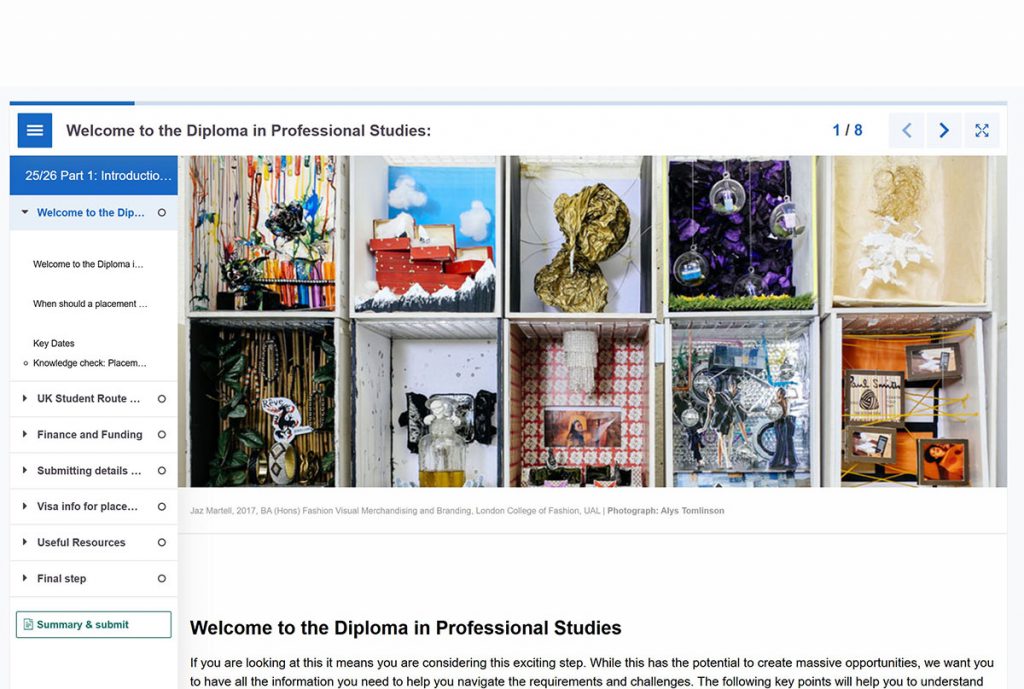
I worked closely with DPS team to design, develop and implement two asynchronous learning modules that helps staff to track students’ engagement.
It was important to me that we provide students with the opportunity to actively engage with the material. Students should not be passively told what it is that they need to know. To ensure learning occurs, students’ thinking needs to be stimulated.
Action
There are lots of tools available across the market that I could use to build an interactive learning experience. I looked at a few different options for creating such a module. One of the tools I considered was Adapt. I had seen an example of a Health and Safety Module created for students at London College of Fashion. This was integrated into Moodle and had quizzes integrated throughout the module.
Another tool I considered was the H5P content library. This could then be integrated into Moodle. The H5P plug in was integrated into Moodle and when H5P activities are submitted the result is recorded in the Moodle grade book. This meant that staff could see who had completed the activity.
In the end I chose to develop the modules out of H5P. While you can achieve very similar things with these two tools, ultimately it was licensing that really made the decision for me. To get access to the Adapt builder I needed to get access to one of the UAL licenses or the programme had to purchase another. While, however, the H5P library is freely available and integrated into Moodle already.
Once I had decided to go with using the H5P Library another set of decisions opened. Should I add the content to a Moodle page and create the interactive elements using H5P or should I create something more self-contained by using a H5P book. The original requirements influence this choice. Students from different courses had to be able to access the module. Considering the student experience, I felt it would be easier for students to access the content from their current Moodle pages. This meant setting up the module as a self-contained book. Having the book contained in their current Moodle pages also made it easier for administration teams working with certain courses to track the students that had completed the module.
Once the module had been built, I recruited testers from the staff. I asked my Digital learning colleagues and academic staff to review it to ensure it would be ready to be released to students.
Finally, I trained the administration staff connected with the DPS to track student completion.
In April 2022, the modules were released to the students.
Results
The outcome of the project was two core Diploma in Professional Studies modules. Part 1: Introduction to the Diploma in Professional Studies and Part 2: Navigating the workplace.
They are fulfilling their intended function; this is to ensure also students wishing to undertake the Diploma in Professional studies were given all of the essential information they needed in advance of applying to take part. In 2021, about 25 students attended the core briefings for the DPS year. In 2022 we tracked 227 students who completed the module. They are also continuing to be used. This year 221 students completed both modules. This is down to two things. Firstly, students can complete the unit in their own time. So, they are no longer at the mercy of timetable clashes, work commitments or even caring responsibilities. The second reason is that integration with Moodle makes it much easier to track students’ progress. If the student has submitted the module, then it will show up in the grade book. It gives staff the analytics that they need to help them keep track of students.
Reflections
I do consider the modules to be a success. There is of course room for improvement. This has been identified from feedback from the DPS coordinator. One issue with the module is that it is embedded on 7 different Moodle pages. Ideally, to make it easier for the DSP team to track, they would like to see one central Moodle page for all the students preparing to take the DPS. This for me would need more consideration, as after all we had decided to keep the module integrated within the student’s course page. I think the creation of a single Moodle page would only benefit the students if there was a more centralized approach to the information and support the students received around the DPS and until that happens I don’t think it could work.
While I generally love working across the whole college. One of the downsides for me is that we are not embedded within the courses we work with. This means it’s much harder to follow up things in the longer term. I have been reflecting that while the data shows us that students are engaging with the module. What we need to know now is how useful that information was while they were undertaking their placements. As a next step for the module, I would like to undertake research with students returning from their sandwich year. To see if they found the information helpful, or to find out if there is anything else we should include.
Evidance
-

1b: Technical knowledge and ability in the use of Learning Technology
Situation
The Digital Learning team at Central Saint Martins is a small, central support team assisting staff and students in using the suite of digital learning tools available at the University of the Arts London. Our core platforms include Moodle and its associated plugins such as Turnitin, Panopto, and H5P, along with supplementary tools like MyBlog (WordPress), Workflow (Mahara), Padlet, and Miro. Additionally, we provide guidance on productivity tools like PowerPoint and MS Teams where they intersect with teaching and learning, such as delivering live online sessions.
Our responsibilities are divided into four key areas:
- Advising staff on best practices for using digital tools in their teaching.
- Working with academic teams to design structure and content for Moodle.
- Designing and delivering staff development sessions tailored to course-specific needs.
- Acting as the first point of contact for troubleshooting issues faced by staff and students.
Unlike larger teams with specialized roles, our team structure assigns us responsibility for supporting specific programmes. This structure allows us to develop a deeper understanding of each programme’s needs and build strong working relationships with staff. I am responsible for supporting Foundation, Spatial Practices, Fashion, and Graphic Communication Design.
Task & Action
Below, I provide two examples of the type of work I undertake to support two of these programmes—Foundation and Graphic Communication Design
Working with Foundation
Foundation students are required to create a Workflow portfolio for each part of their course. However, students often struggle with the platform initially, and academic staff require portfolios to be set up in a specific way. Additionally, Workflow has usability challenges and occasional bugs, making support essential.
To address these challenges, I have:
- Delivered training to staff on how to introduce students to Workflow effectively.
- Designed and delivered student training sessions at the start of each term to ensure they understood how to use Workflow for their assignments.
- Held regular drop-in sessions where students can seek assistance with Workflow-related issues.
- Worked closely with tutors to redesign assessment practices, ensuring Workflow is used effectively and aligns with course learning outcomes.
Working with BA Graphic Communication Design
In the Graphic Communication Design programme, MyBlog (a WordPress-based platform) decided to use the platform as a way to share resources within the community.
Workflow (Mahara) Training and Support
My work in this area has included:
- Creating an instructional video demonstrating how to add posts to a shared resource blog.
- Provide troubleshooting support for technical issues relating to the use of MyBlog, ensuring smooth operation for both staff and students.
Results
Providing embedded support within the course can help to:
- Increase student confidence in using various digital platforms.
- Reduce technical barriers, allowing students to concentrate on their learning and creative outputs.
- Improve alignment between digital tools and assessment practices through collaboration with academic staff.
- Promote digital skills among the student population.
Evidance
Supporting students on the Foundation:
Trouble shooting for BA GCD

-
1c: Supporting the deployment of learning technologies
Situation
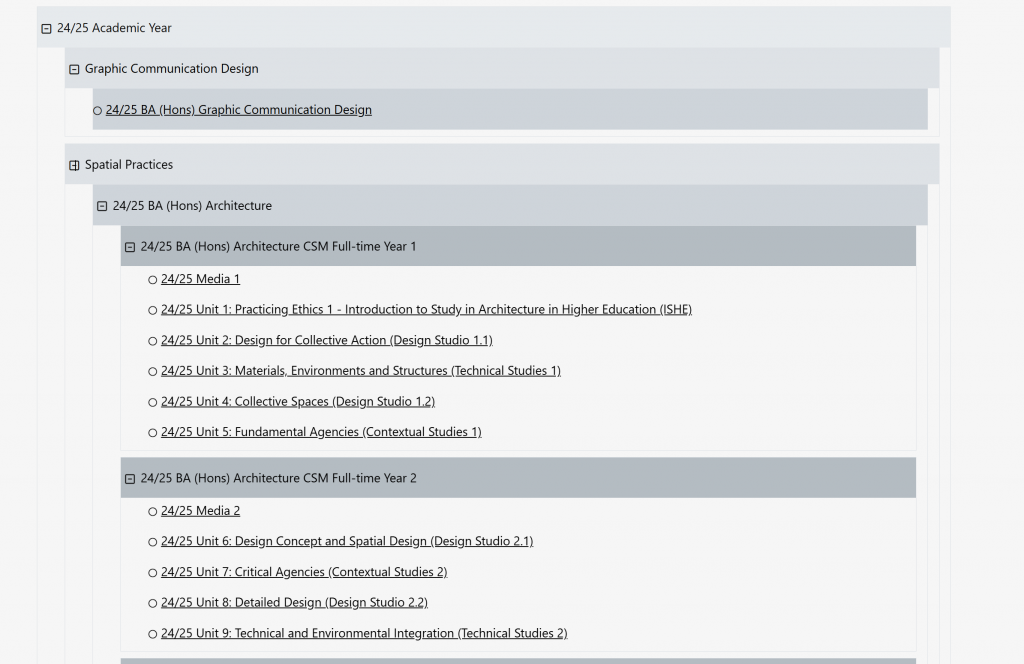
The Digital Learning team at Central Saint Martins acts as a bridge between the central Digital Learning Support team and the college. During the summer, we collaborate with the central Digital Learning team to ensure a smooth Moodle rollover process. This involves numerous tasks on the college side, including:
- Ensuring that new unit names, manually entered into SITs as part of the validation/modification process, are correct.
- Checking the Course Hierarchy, a structure unique to the University of the Arts London that determines how Moodle courses are displayed in students’ ‘My Courses’ area.
- Managing visibility settings for the appropriate units, staff enrollments, and ensuring the correct content is rolled over.
Task
My role in this process was to manage the Moodle rollover process for the college, working closely with the central Digital Learning Support team and College Admin teams to ensure the accuracy of imported data from SITs.
Action
- Attended meetings with the central Digital Learning team to align processes and expectations.
- Disseminated key timeline information to my team and the wider college to ensure clarity and coordination.
- Designed and delivered training for Course Support Administrators (CSAs), equipping them with the skills needed to check course structures and staff enrollments.
- Acted as a triage point for issues raised by the admin teams, resolving problems where possible and escalating through ticketing systems when necessary.
- Tracked issues through to completion, ensuring that rollover tasks were completed efficiently and correctly.
Result
Having worked at CSM long enough to remember when there was no dedicated college-based support for this process, I have seen the impact of these improvements firsthand. Previously, administrators were not trained to check Moodle courses, leading to common issues such as incorrect course visibility settings. With structured support and training, we have significantly improved the accuracy and efficiency of the rollover process.
Key improvements include:
- Increased confidence among CSAs in managing Moodle rollover tasks.
- Greater accuracy in course structures and unit visibility, reducing confusion for staff and students.
- A more streamlined and efficient process, minimising errors and reducing the need for last-minute fixes at the beginning of term.
Evidance
Reflection
What?
The Moodle rollover process is crucial for ensuring that students and staff have access to the correct courses and materials at the start of each academic year. Without proper oversight, errors can create confusion and disrupt teaching and learning.
So What?
However, I have noticed that often we are addressing the same issues that come up year on year following the rollover. I have also noticed that due to the large staff turnover in the Course Support teams, it’s hard to build up knowledge in the team.
Now What?
Going forward, I aim to:
- Develop additional training resources to further support CSAs and reduce reliance on live training sessions.
- Work with the central Digital Learning team to reduce issues that keep cropping up year on year.
-
2a: An understanding of teaching, learning and/or assessment Processes
Situation
My teaching practice centres around developing and delivering digital learning workshops. I work to design deliver bespoke sessions that meet the needs of the staff at the college. I have also instructed students at Foundation, Undergraduate and Postgraduate levels. For example, I have designed a delivered digital skills workshop for Foundation students using workflow for their assessments.
To help me develop my work in this area I have undertaken various UAL staff development activities and qualifications. I completed the Thinking Teaching staff development session and followed up by completing the PG Cert in Academic Practice at UAL. Once I had completed that I also obtained my FHEA status with Advance HE.
Task
The Digital Learning team are tasked with providing staff develpment session for the suite of digital learning tools avalible to us. This inlcudes Moodle, MyBlog, Workflow, Miro and Padlet.
As a team we work together to sketch out our prioirties for the term. Weather it be training admin staff to carry out the rollover procedures or providing staff with referesher training on how to add content to Moodle. This is to ensure the sessions are timely and relevant to staff.
Action
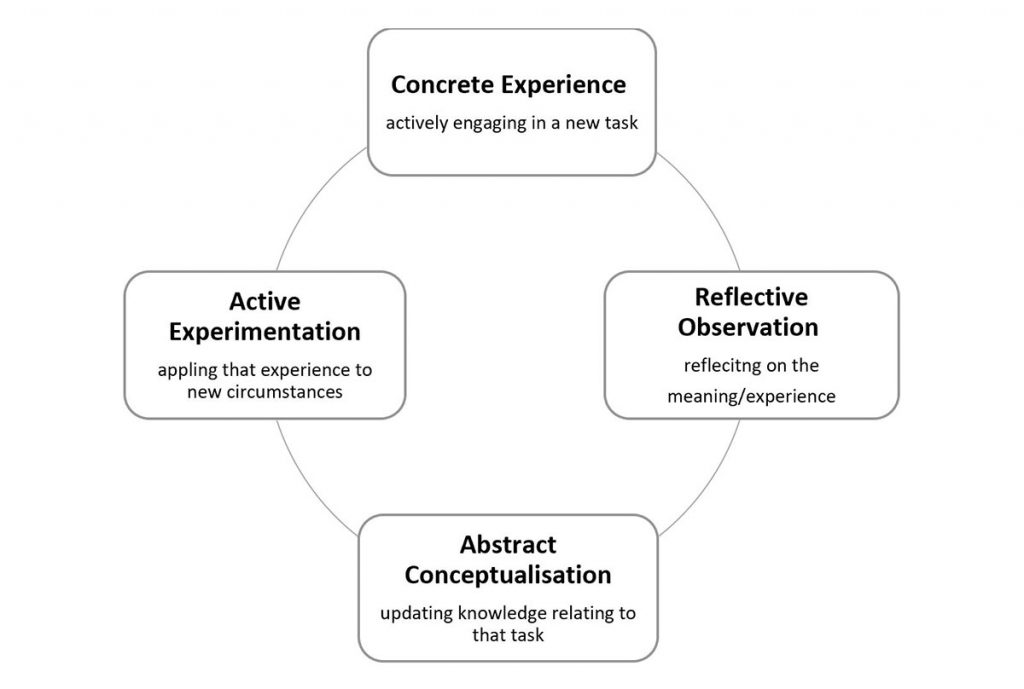
When I design digital skills sessions for either staff or students, I will always include a chance for the participants to have a go themselves, learning by doing, otherwise known as Experiential Learning.
Ideas about learning by doing or experiential learning have been around for a long time. Constructivist theorist John Dewey (1934) is often regarded as one of the key figures influencing thinking in this area, and David Kolb (1974) published his experiential learning cycle.
Results
By making space for hands-on learning, I think it can help to make the sessions more engaging and relevant. It will also improve outcomes for participants by ensuring the attendees are actively participating. However, there are always things to reflect upon to make improvements continually.
Reflection
What?
One of the things I struggle with the most, especially when delivering sessions online, is the balance between how long a demonstration is and setting the participants up for practice tasks.
So What?
I notice that some people try to follow along at the same time as I am demonstrating, and others wait until I have finished. I tend to encourage people to wait until I have finished demonstrating, as I feel this will push the participant into thinking through certain steps themself rather than just copying and improve the likelihood of retaining information. I also feel it is easier to miss steps if you are doing something while someone else is showing you another. However, I feel some people are impatient to try for themselves.
Now what?
Sometimes I experiment with the tempo. For example, I take a couple of steps and then ask them to do the same. Allowing space for questions and going much slower than I might ordinarily. Ultimately, I think it depends on the complexity of the task and the skill level of the participants. Each session needs to be designed individually and reviewed once it’s completed. If you do this, it makes it easier to adjust for the next session.
Evidence
Feedback from the sessions
PG Cert certificate
FHEA certificate
Plans
-

2b: An understanding of your target learners
Understanding Learners’ Needs Through Evaluation
Understanding our learners’ needs is a vital part of my work. I ensure there are moments to gather student feedback during consultations, testing, and evaluation phases of the projects I undertake. A key example of this is my work with the Creative Unions unit.
Creative Unions is a cross-course unit that emphasises collaboration. It is a large-scale initiative; this year, over 1,000 students will participate in the unit simultaneously over five weeks. Delivered through a blended learning model, I partner with the Unit Leader to plan and develop the digital components of the unit. My responsibilities included structuring the Moodle environment, setting up Miro boards, and facilitating all live online events.
The goal is to integrate the digital elements seamlessly with face-to-face teaching, ensuring all students could access the resources and information needed to complete the unit successfully. Given the scale of the unit, the digital content is crutial; students missing live events or recordings could lose significant learning opportunities. Additionally, with 27 Associate Lecturers facilitating the unit, Moodle and Miro became essential tools for delivering a consistent learning experience. This consistency is especially important as the unit has been to growing year on year.
Task
At the outset of my work with Creative Unions, I recognised the importance of understanding how students experienced the digital elements of the unit. This understanding would allow us to make necessary adjustments and ensure our systems were robust enough to support the growing numbers.
Action
To address this need, I implemented an annual evaluation process following the completion of the unit. This process included:
- Focus Groups: I recruited students who had recently completed the unit to participate in focus groups. These students were incentivised with National Book Tokens to encourage participation.
- Data Analysis: I examined analytical data from Moodle to track engagement and identify potential issues with access or navigation.
- Surveys: Teaching staff, including the 27 Associate Lecturers, were asked to complete surveys to provide feedback on their experiences with digital tools and resources.
- Reporting: After collecting and analysing data, I identified patterns, produced a report, and made recommendations for improving the unit’s digital delivery in its next iteration.
Results
In 2023, the evaluation process enabled us to identify and address the following key issues, as well as validate the elements that were working effectively. Some significant outcomes included:
- Moodle: Feedback from students indicated that they appreciated having all necessary resources gathered in one place and made available in advance, which allowed them to manage their time more effectively. However, some students still expressed feeling overwhelmed and struggled to locate information quickly, particularly regarding lecture recordings and the reflective journal template. To address this, we implemented color-coding for topics and sections to help students find information more easily, and we added recordings to the online sessions topic.
- Communication: Students expressed their dissatisfaction with receiving multiple Teams links in their calendars, as it made it difficult for them to locate the correct one. In response to this feedback, the CU lecture Teams room set-up was changed. Instead of multiple links, there is just one room with a single link. This change has resulted in increased attendance at optional sessions, including those offered for library and academic support.
- Miro: Responses from students showed a significant divide in their opinions about Miro. Many acknowledged the usefulness of the Miro board, especially when they missed a class and needed to catch up. However, some students felt that the extensive use of Miro activities during in-person sessions negatively affected team interactions. As a result of this feedback, there has been a decision to reduce the number of Miro activities and an effort to encourage students to discuss topics face-to-face and upload images and work once the discussion has been completed.
Reflections
Reflecting on this evaluation process, I see both advantages and limitations. Holding a focus group with students immediately after the unit allows me to identify key trends and issues they have experienced. By providing prompts for discussion, the format encourages students to express their concerns in their own words, offering valuable qualitative insights.
However, one noticeable challenge is the relatively small number of students participating in the focus group, especially given the unit’s large scale. For example, only six students attended the previous session. While focus groups are intentionally smaller due to their discursive nature, participation remains limited despite incentives and online sessions.
This raises the question of whether we should reconsider the timing of the focus group, currently scheduled after the unit ends. Or explore alternative forms of incentivisation to encourage greater participation. The simplest way to increase participation might be to start recruitment earlier and ask the facilitators to encourage participation.Another strategy would be to combine the student focus group data with the student survey text responses. This could help to reassure that the themes were representative of a broader group.
-
3a: Understanding and engaging with legislation
A journey to towards digital accessiblity case study
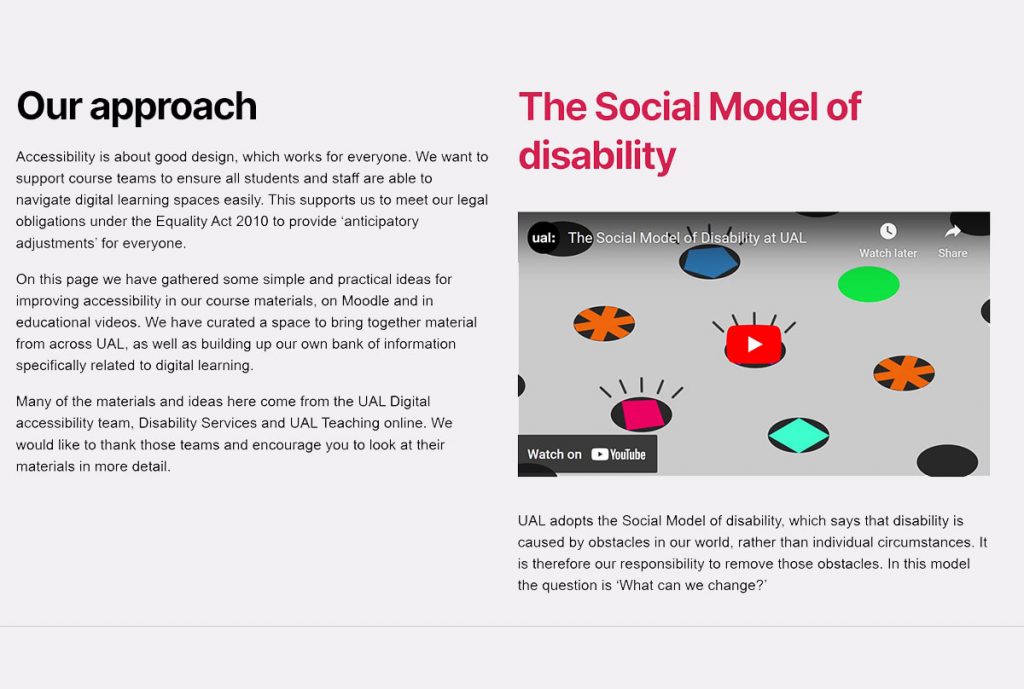
Accessibility legislation has been a cornerstone of my work at Central Saint Martins (CSM), deeply influencing my approach and initiatives. The Equality Act 2010 and the Public Sector Bodies (Websites and Mobile Applications) Accessibility Regulations 2018, along with the Web Content Accessibility Guidelines (WCAG), have provided a framework that guides my practice in ensuring digital inclusivity.
My journey into the world of digital accessibility began during my MA in Digital Media Design. A pivotal moment came when I discovered a podcast that illuminated the profound impact technology can have on disabled individuals. This experience sparked my commitment to embedding accessibility into all aspects of my work, recognising its potential to transform lives.
I am also influenced by my positionality, as I have moderate dyslexic traits. Technology features such as spell check and text-to-speech tools are vital to me.
At UAL, a creative arts institution, we have a slightly higher percentage of students declaring disabilities, particularly neurodiversity. I believe we have not only a legal obligation to make our content accessible but a moral obligation too. Doing so also has much broader benefits.
Task
One of the main challenges we face is that staff have never been trained to create accessible documents for students, leading to ingrained habits and ways of working that need to be updated. I work toward empowering academic teams to make content on Moodle accessible. This involves not just the platform itself, but also how we populate and use it.
Action
In response to these regulations, I have developed and delivered regular staff development sessions focused on creating accessible documents using Word, PowerPoint, and PDF. These sessions have been crucial in raising awareness and building competency across the institution.
Understanding the constraints on staff time, I also created asynchronous resources, including an accessibility guide on my blog and practical guidelines for making Moodle content more accessible. These resources support staff in integrating accessibility into their work at their own pace.
Moreover, I was integral in the initiation of working groups: the CSM Accessibility Action Group and the UAL Accessibility Best Practice Group. These groups aim to foster a collaborative approach to accessibility, sharing best practices and driving continuous improvement across the university.
Results
These initiatives have significantly elevated the conversation around accessibility at UAL. Engagement has expanded beyond individual departments to include entire teams, such as the UAL Awarding Body, the CSM Quality Team, and the BA Fine Art team. This widespread involvement highlights a growing recognition of the importance of accessibility across the institution.
Reflections
I am proud of our achievements in raising awareness of digital accessibility so far, but it often feels like we are only scratching the surface. Especially at those time we organise a university-wide training sessions, yet only two or three people attend. It feels like we are moving a mountain. However, there are rewarding moments when we can engage the entire team, which feels like a significant victory.
For some time now, I have felt the need to gain the attention of senior management at the college. With the support and buy-in from senior managers and program directors, we would be able to mandate training for larger groups of staff and potentially reach hourly-paid academics as well.
One strategy I am working on as part of the CSM Accessibility Action Group is to produce a report for presentation at the College Academic Committee. Unfortunately, due to other work priorities, progress on the report has stalled. I believe it is time to resume work on it to address the challenges we face in reaching staff for digital accessibility training.
I would also like to share my thoughts on teaching students digital accessibility. Recently, I was in a meeting with a BA Graphic Communication Design student who needed assistance sharing an audio file she had created for her critical studies report. One of the submission requirements was to produce a designed digital or printed copy of the report, and this student went above and beyond by creating an audio file to make her essay more accessible. She had said she also wanted to add alt-text to her images, but hadnt had time to investigate how to do that. Her efforts made me reflect on the importance of educating students about digital accessibility.
My next step in this area is to attend the Southampton International Symposium on Teaching Accessibility. This event comes at a perfect time for me, and I am eager to learn how other institutions and accessibility professionals are tackling this important issue.
At CSM, I have two options for reaching our students. The first option is to organise stand-alone sessions for students that are separate from their courses. This would be the easiest approach to implement. The second option is to collaborate with the GCD Stage 2 leader to explore the possibility of embedding a session within the course curriculum. While this second option would allow us to reach more students, it would be more challenging to arrange but could serve as a valuable pilot program. I think ultimatelly it would be good to try both approaches.
-
3b: Understanding and engaging with policies and standards
Core Principles: CP 3 / CP
Situation
The University of the Arts London (UAL) introduced a new policy requiring the recording of in-person teaching sessions to enhance accessibility and inclusivity.
This policy aligns with UAL’s commitment to the Social Model of Disabilities, which emphasises removing barriers to ensure equal access for all students.
The release of this policy coincided with my undertaking the second unit of the PG Cert – Inclusive Practice Unit.
My response to the release of this policy was to produce a digital resource in the context of my unit focusing on inclusive practice.Task
My first task was to emphasise why it was important for staff to understand how recording live teaching could benefit students. The second was to support our academic staff to achieve this.
To achieve this, I needed to identify a straightforward and accessible workflow that staff could follow to achieve what the policy was recommending.
Action
So, as a direct response to the UAL Education Video policy, and taking inspiration from the disabilities team resource ‘Recording Taught Sessions’, I designed and developed a webpage that explained the importance of recording in-person teaching with case studies, provided step-by-step instructions, including best practice and trying to address some of the major concerns around recording teaching. This would allow staff to access this information in their own time.
To complement the webpage, I created a quick reference print sheet that staff could easily access and print to use as a guide during their teaching sessions.
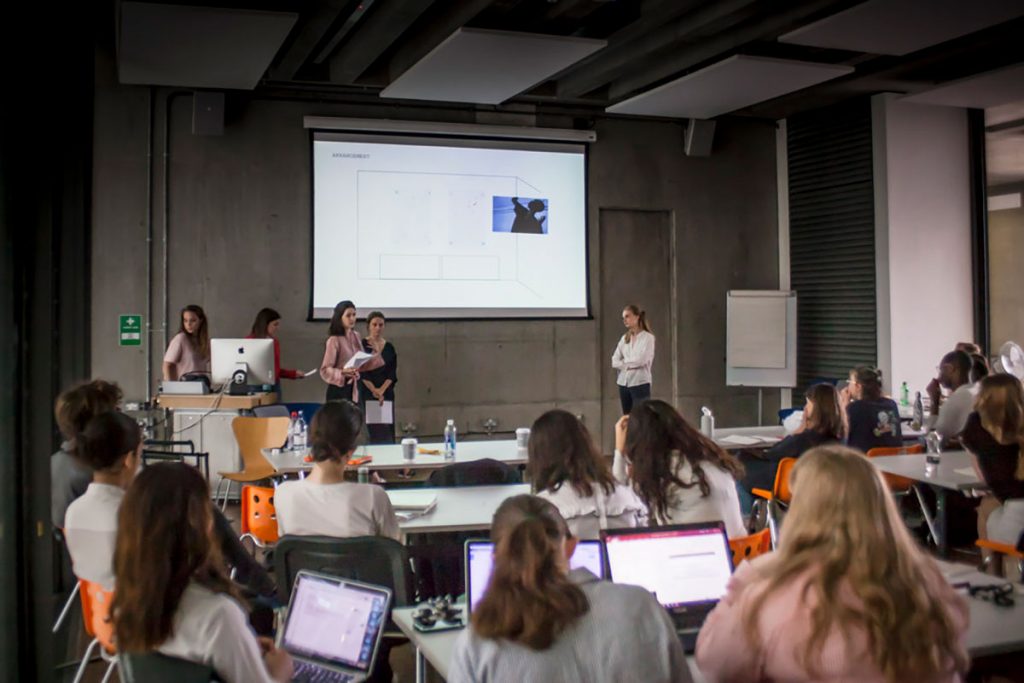
To build on this work, I organised and led a training session to help staff build their confidence in recording their live lectures. This session was designed as a live, in-person session to replicate their actual teaching styles. This would allow staff to get hands-on experience in an environment they would be teaching in.
Results
The resources and training sessions helped some staff understand the importance of recording their teaching sessions and how to do it easily within the constraints of the technology available to us at UAL.
I also believe the addition of a training session was important for some staff. Providing staff with an alternative way into the topic. Those staff who attended the session reported they found it useful.
Reflections
Ultimately, however, this topic is still quite controversial at CSM. Teams are also quite siloed. There are still lots of staff who link recording to reduced attendance or issues with intellectual property. This is then coupled with issues around the technical infrastructure. Issues of mics and WIFI in seminar rooms. So it feels like a mountain to overcome. As our team is quite small, it feels like our voice seems quite small in the mix, and without the ability to mandate the process, it still feels like a hard sell.
There is currently work underway, looking at the current state of AV systems in the building. I think this will help us to understand the technical challenges that staff face. I hope it will help us to address the practical barriers. In terms of providing staff with a more consistent experience and useful guidance on how to use the equipment.In terms of overcoming the ideological objections, I think we need to put more work into countering the narratives. There are two ways we can do this: by highlighting the research around this issue. However, I think it would also be useful to harness the student voice more. We just need to keep talking about it.
Evidence
Policy
Social model of disablity
Get statement from Wande
Feedback from Carys
Session plan